Pet Emergency Kit: Complete Guide for Dogs and Cats 2026
Build your personal emergency plan
Free, no sign-up, takes 5 minutes.
After Hurricane Katrina, FEMA-commissioned researchers documented something that’s still true today: 71% of people who didn’t evacuate in time stayed because they wouldn’t leave their pets behind. Not because they had no transportation. Not because they ignored the warnings. But because they had no plan for their dog or cat.
That detail changes everything.
The plan, I mean. Not the kit. The plan. Because you can have the best go-bag in the world with the perfect kibble and the most solid carrier on the market — and if you haven’t practiced getting the cat into that carrier in under two minutes, in a real emergency you’ll lose 15 to 20 minutes chasing them around the house while sirens go off. After Hurricane Helene in 2024, that was exactly the failure of one family in Western North Carolina. They got the cat. But they were the last ones out.
At EmergencyKitLab we’ve published emergency guides for families for years, but pets always ended up in a paragraph at the end. That changes today. Here you’ll find real water and food quantities, separate checklists for dogs and cats, and what to do when the local shelter doesn’t accept animals — because in many US disasters, less than 30% do.
What does a pet emergency kit actually contain?
A pet emergency kit is the set of basic supplies — water, the same brand of food they normally eat, an appropriate carrier, and proper documentation — that keeps your dog or cat safe during the first three days of an evacuation, without depending on stores, vets, or electricity.
Your pet’s kit isn’t separate from the family plan. It’s inside it. Same logic as for people: 72-hour minimum autonomy, documents in order, no dependence on stores or power.
The basics:
- Water — calculated by weight and species (quantities below)
- Food — the exact brand they normally eat, no exceptions
- Carrier — hard-side for cats; soft can work for calm dogs in short evacuations
- Documentation — registered microchip, vaccine records (PDF on phone), updated photo on phone
- Muzzle — even if your dog is the calmest in the neighborhood. Under stress, any animal changes
- Extra leash and harness — never just the collar. Cats slip out; scared dogs do too
- Pet first aid kit
- Chronic medication if applicable
Here’s something most guides don’t mention because it seems minor: changing food during stress causes gastroenteritis in dogs in 12-24 hours, in cats in 24-48. This isn’t the moment to try a new brand because it’s what the store had. Carry the exact reference your pet eats, with stock rotated every 3 months.
We’ve seen pet kits with 8-month-old kibble inside. Oxidized fat, rancid smell. Your pet will refuse it exactly when you need them to eat. That doesn’t qualify as an emergency plan.
How much water your dog or cat needs in an emergency
According to AVMA and emergency veterinary guidelines, water needs under normal conditions are 0.5-1 fl oz per pound of body weight per day for dogs and 0.6-1 fl oz/lb/day for cats. Under heat or stress, those amounts can double.
In an evacuation with high temperature and a scared animal, expect them to double.
Water needs by dog size (72 hours):
| Size | Weight | Normal/day | Under heat/stress | For 72h (+ 20% margin) |
|---|---|---|---|---|
| Small | 11 lb | 4-12 fl oz | up to 24 fl oz | ~80 fl oz (2.5 qt) |
| Medium | 35 lb | 12-18 fl oz | up to 32 fl oz | ~3.5 qt |
| Large | 65 lb | 24-32 fl oz | up to 60 fl oz | ~6 qt |
Cats (7-11 lb): 4-12 fl oz/day under normal conditions. Up to 24 fl oz/day under heat or stress. For 72 hours: ~2 qt with margin, though wet food significantly reduces this.
A note on cats: under normal conditions they get most of their water from food, not from drinking directly. Wet food provides about 70-80% of daily water. If you carry 3 days of wet food, you halve the free water you need to transport.
For 72 hours of evacuation: daily quantity × 3 + 20% margin.
Food: brand exactly the same as daily
Not “similar.” Not “from the same line.” The exact same. The pet’s gut microbiota is adapted to one specific formulation. Switching during stress = digestive upset = an animal that won’t eat = an animal that gets weak in 48 hours.
Quantities for 72 hours:
- Small dog: 2-3 cups dry kibble (8-12 oz total)
- Medium dog: 6-9 cups (1.5-2.5 lbs)
- Large dog: 12-18 cups (3-5 lbs)
- Cat: 1.5-2.5 cups dry, OR 9-12 wet food cans (3 oz each)
Vacuum-pack in 1-day portions. Rotate every 3 months — more often than human food because pet kibble fat oxidizes faster.
The carrier: most underrated decision
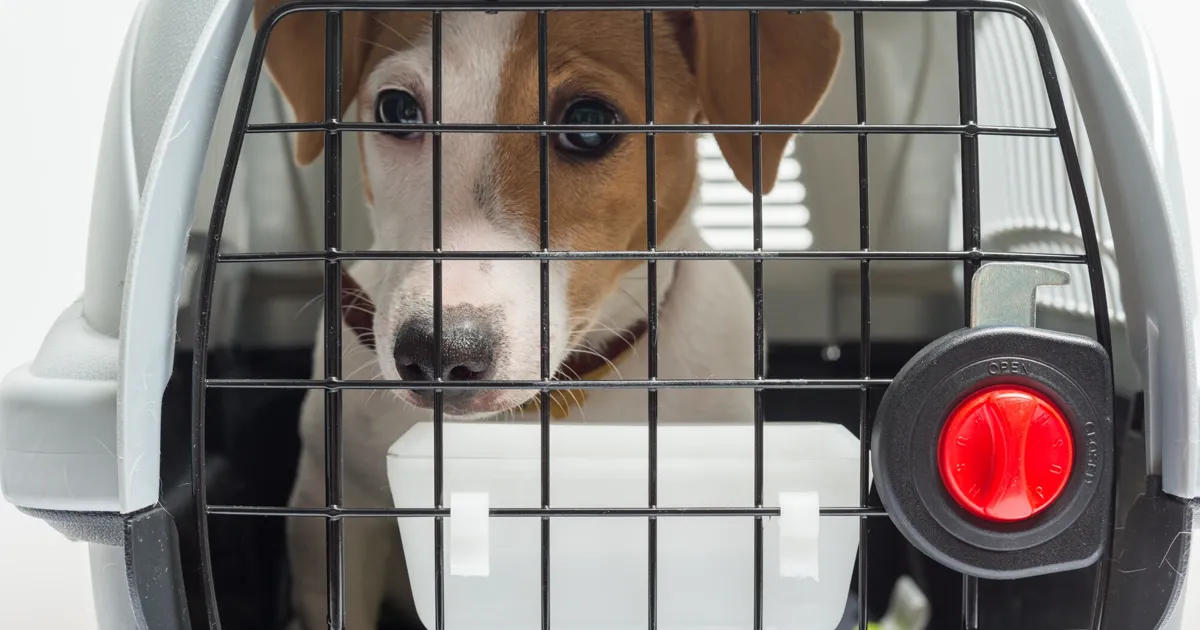
For cats, a hard-side carrier is non-negotiable. Soft carriers fail under panic, stress, or extended evacuation. A scared cat in a soft carrier with a ripped zipper is a worst-case scenario.
For dogs:
- Calm small/medium dog, short evacuation (vehicle to shelter): soft carrier okay
- Reactive or large dog: hard-side or properly fitted harness with car seatbelt attachment
- Multi-day evacuation: hard-side, no exceptions
Practice. The carrier is a tool — and like any tool, it requires training. Leave it out at home as furniture, with treats inside, for weeks before the emergency. Both for cats and reluctant dogs.
Documents: what you need and where
Most US emergency vet stations and pet-friendly disaster shelters require:
- Microchip registered in your name with current address and phone (verify at AAHA Universal Pet Microchip Lookup)
- Current vaccination records — rabies above all (PDF on your phone + paper copy in a waterproof bag in the kit)
- Recent photo of pet with you (proves ownership if separated)
- Veterinarian contact info including 24-hour emergency vet near you
- Description sheet: breed, color, sex, age, distinguishing marks, chronic medications, special diet
Pet first aid kit
Minimum:
- Sterile gauze and self-adhering bandage (Vet Wrap)
- Hydrogen peroxide 3% (for inducing vomiting in dogs ONLY if instructed by a vet)
- Saline solution for eye/wound flushing
- Tweezers (for ticks and splinters)
- Pet-specific thermometer (digital rectal, normal range 100-102.5°F)
- Diphenhydramine (Benadryl) — dose only with vet approval (1 mg per pound)
- ASPCA Animal Poison Control number: (888) 426-4435 (charges may apply)
- Local 24-hour emergency vet phone
Critical: Never give acetaminophen (Tylenol) to cats — lethal. Never ibuprofen (Advil) to dogs or cats — toxic. Never chocolate, grapes, raisins, or onions to either.
What to do if the shelter doesn’t accept pets
This is the most likely problem in real US disasters. The PETS Act (2006) requires emergency planning to consider pets, but actual implementation varies wildly by jurisdiction.
Pre-disaster plan:
- Pet-friendly hotels within 30-50 miles — book the list of 5+ in advance. Apps like BringFido help.
- 24-hour emergency vet outside the affected area — most board pets temporarily during disasters
- Family member or friend in another city — pre-arranged
- National pet-friendly hotel chains — La Quinta, Motel 6, Best Western, Red Roof Inn (varies by location)
- Local animal shelter or humane society — many activate emergency boarding during disasters
Don’t improvise this in the moment. Put the list in your kit, on paper, with phone numbers.
Vehicle and evacuation
If you evacuate by car with pets:
- Pet stays in carrier or harness with seatbelt attachment — never loose
- Never leave a pet in a car at temperatures above 70°F outside (interior reaches 100°F+ in 10 minutes)
- Stops every 2-3 hours for water and bathroom breaks for the dog
- Cats: limit interior visibility (cover carrier with cloth) to reduce stress
- Vehicle kit: portable water bowl, leash, waste bags, cleanup supplies
Our vehicle emergency kit guide covers full vehicle preparation.
Mistakes to avoid
1. Untrained carrier: Without practice, cats hide and scared dogs resist. 15+ minutes lost.
2. Generic food substitutes: Causes gastroenteritis. The brand matters.
3. Outdated microchip data: Phone or address changed and you didn’t update. The animal can’t be returned to you.
4. No alternative shelter plan: “We’ll find something” doesn’t work at 11 PM with the storm coming.
5. Forgetting chronic medication: Diabetic dog without insulin = veterinary emergency in 24-48 hours.
6. Soft carrier for cats: Fails under panic.
7. No pet first aid kit: Human meds can kill them.
Final thoughts
Your dog or cat depends 100% on you in an emergency. They can’t read warnings, can’t pack a kit, can’t find a vet. The kit and the plan are the difference between a stressful but resolvable evacuation and a tragedy.
The good news: you don’t need to spend $200. A used hard-side carrier, a 1-gallon water container, vacuum-sealed kibble, the vet folder in a waterproof bag and updated microchip costs less than $50 and saves the family member with four legs.
Build it this weekend. Practice the carrier. Update the chip. Save the emergency vet number. The next storm or wildfire isn’t going to wait for you to be ready.
For full preparation, our emergency preparedness ultimate guide covers the complete picture.
Information in this article is general and does not replace professional veterinary advice. In a real emergency consult your vet, ASPCA Poison Control (888-426-4435), or the nearest 24-hour emergency vet.
EmergencyKitLab participates in the Amazon Services LLC Associates Program. When you buy through our links, we earn a small commission at no extra cost to you.
Looking for products mentioned in this article?
Products reviewed by our team on Amazon, all rated 4+ stars.
Emergency preparedness editorial team
The EmergencyKitLab editorial team. Emergency logistics specialists and first responders. We write from real-world experience with supply disruptions and natural disasters.
Frequently Asked Questions
How much water does a dog need in an emergency?
Can cats take Tylenol if injured?
What if the emergency shelter doesn't accept my pet?
Do I need a microchip for my pet to be accepted in a disaster zone?
How do I get my cat into the carrier fast in an emergency?
Related Articles
72-Hour Emergency Kit 2026: Checklist + Budget (Family)
EmergencyKitLab 2026 guide: complete 72-hour kit checklist from $50/person. Winter Storm Uri-tested tips + the #1 water mistake families still make.
15 min readFamily Evacuation Plan 2026: Step by Step
Escape routes, meeting point, roles for each person, and practice drill: create your family evacuation plan step by step and act before the emergency arrives.
9 min readVehicle Emergency Kit: Complete Guide for Your Car 2026
What every car emergency kit needs: from winter blizzard survival to summer breakdown. Real US data, products tested, what saves lives and what's filler.
9 min read